

What Every Scene Needs
7 Essentials for Page-Turning Fiction

When a scene feels “off,” it’s almost always because one ingredient is missing: a clear desire, meaningful stakes, or a real turning point. In this post, I walk through what every scene needs to keep readers turning pages. Is there a scene in your draft that you secretly skip when you reread? That’s often the perfect place to start.
Strong scenes aren’t random events – they follow a reliable structure that builds tension, reveals character, and propels the story forward. Whether you write fantasy, thrillers, memoirs, or something else, mastering these elements turns flat passages into page-turners that honor your reader’s attention.

Every scene needs to start with clear desire
Your protagonist enters the scene wanting something specific and immediate – survival, information, connection, revenge. This isn’t vague backstory; it’s the “why now?” that gives the scene urgency. Without it, readers drift because nothing feels at stake.
In a fantasy quest, the hero might desire a hidden map to evade pursuers.
In a thriller, a detective craves a confession before the killer slips away.
Tie this desire to the larger story arc so every scene feels essential, not filler.
Inciting incident: the spark that disrupts
Right away, something interrupts the character’s plan – an inciting incident that knocks them off balance. This could be a betrayal, discovery, or external threat, but it must complicate the desire and raise the cost of failure.
Progressive complications follow: smaller obstacles that escalate tension, forcing the character to adapt without easy wins. Think layered conflicts – inner doubts plus outer dangers – that mimic real life’s messiness and keep momentum building.
Turning point and crisis: no good choices
The turning point delivers the biggest complication yet, something the character can’t ignore or sidestep. It leads straight into the crisis: a “best bad choice” where every option hurts – fight and risk death, flee and abandon allies, reveal a secret and shatter trust.
This is where stakes crystallize. Readers lean in because they sense the emotional toll, rooting for the character to navigate the impossible. In developmental edits, I often flag scenes missing this pivot – they meander without forcing growth or change.
Climax and resolution: action with consequences
The climax is the character acting on their crisis decision, facing immediate results – win with a cost or loss that reshapes their path. No deus ex machina; outcomes step logically from prior choices, showing how the world and character have shifted.
Resolution wraps the “new normal”: quieter reflection on what changed, planting seeds for the next scene. A strong close leaves readers satisfied yet hungry for more, with the character’s desire evolved or defeated.
Quick checklist: Does your scene deliver?
Use this to diagnose and strengthen drafts:
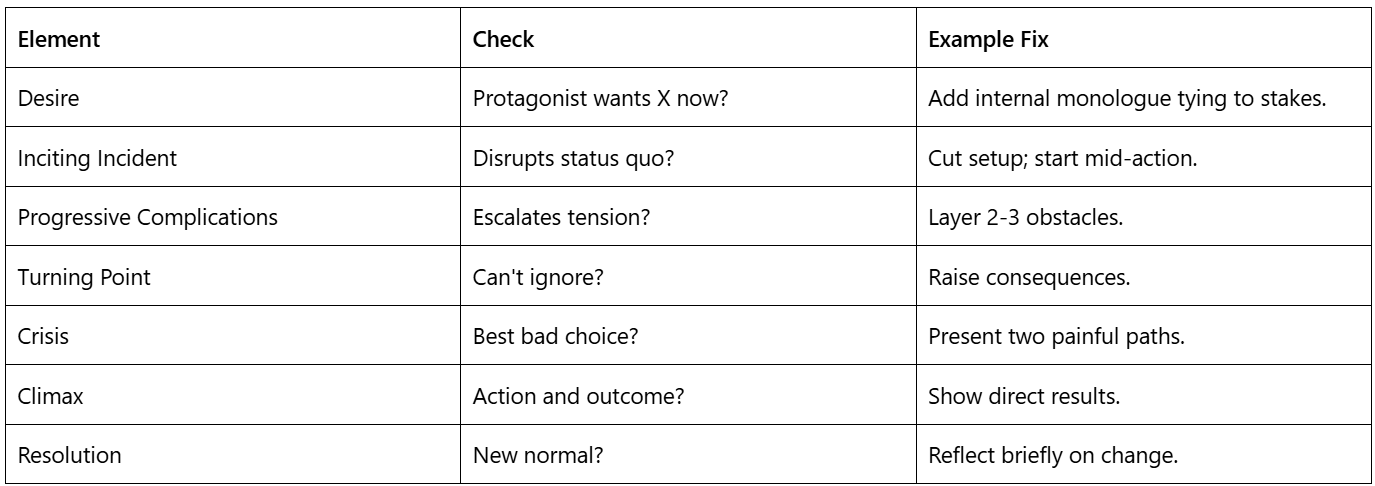
Scenes missing 2+ elements often need restructuring during content editing.
Put it into practice without overwhelm
Revise one “skippable” scene using this framework, then read aloud – does it pull you through? For bigger fixes, a manuscript evaluation spots patterns across scenes, while developmental editing rebuilds them with inline guidance and a story map.
You don’t have to perfect every scene alone. If a draft feels promising but uneven, let’s chat about targeted support to make your story’s heartbeat stronger and more consistent.